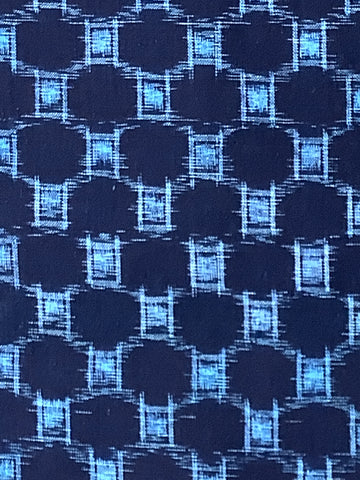
7981:1980s Japanese Tsumugi Silk,Bamboo Stalks,Pixelated, 65in.Piece


Traditional Japanese Textiles:
1980's Japanese Tsumugi (Pongee) Silk Fabric
Pixelated Designs-Bamboo Stalks Motif
Catalog# 7981
Width:14.5 inches / 36.83 cm
Length: 65 inches / 1.65 m
US$20.00 per piece

|
For an excellent 'how-to' do Arai-Hari oneself, we highly recommend Kae Warnock's Blog, Chocolate Factotum: |
Fabric Description Details:
This is a lightweight 1980s tsumugi silk, derived from a kimono by an Arai-Hari cleaner in Japan; fabric is smooth, slight sheen and is minimally translucent, with a cream-white background, but fully pixelated using micro-tiny black plus (+} pixels as background; Note: the motif of 3 bamboo stalks - 1 large, 2 smaller placed off-center; Motif is rendered by use of yellow, light-mustard, teal and plum colors pixels to create the bamboo motif; this style of 1980s and later pixelation is common in Tsumugi due to the weaving methods (please see closeups); We are not sure if this is from Amami Ohshima, but it shares many of the same characteristics.
Colors: Please use our text color descriptions to complement your sense of the fabric due to differences in contrast and color on different devices.
Condition: EXCELLENT,
Recommended for making scarf/accessories.
Characteristics: A plain woven silk fabric with pre-dyed scoured threads both for warp and weft. The color is refined and calm and the fabric is soft and difficult to wrinkle. Threads are dyed with plant dyes such as "Techiki" (Raphilolepis umbellata) and indigo (Persicaria tinctoria) with a technique, peculiar only to "Oshima Tsumugi," called "Ori Jime." As a variety, an additional treatment is made to the dyed thread by dipping them in muddy water. It is "Doro(mud) Zome(dyeing)." There are several kinds of "Oshima Tsumugi":"Doro Oshima," "Ai(indigo) Oshima," "Doro Ai Oshima," "Iro(color) Oshima" and "Natsu(summer) Oshima."
Popular with our antique Japanese textile aficionados and collectors.

YokoDana Kimono
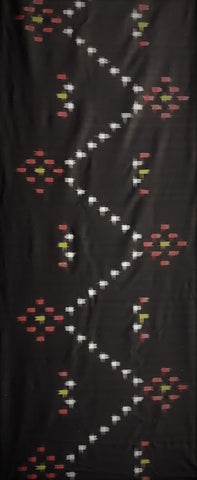
6923: 1930s-50s Deadstock Japanese Meisen Silk Fabric, 1 Yard
Regular price $ 20.00 Sale price $ 10.00
YokoDana Kimono
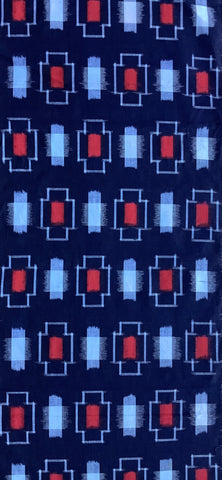
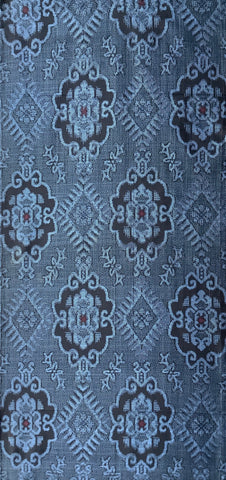
7069: 1970's Japanese Pongee Silk Ohshima Tsumugi, 38 inches
Regular price $ 12.00 Sale price $ 6.00

YokoDana Kimono
7261: 1930s-1950s Japanese Kasuri (ikat) Cotton Fabric 42in Piece(Arai-Hari)
$ 15.00